I still have a box of potato. But I cooked noodle gratin for some days. Partly because if there is an official quarantine period, I may have less time to use kitchen (my landlord may use it more); partly because I really like noodle gratin.
I was still not so excited about my daily work, but somehow excited to create something online with other people. Network ensemble? Live-coding through server? Luckily I got a few feedback which turned to a further discussion.
So I spent some time on it, also sent another application.
I read that Curfew (Ausgangssperre) started in Austria. It’s funny that people are only allowed to go walk “alone or with the people live in the same place”. People who share an apartment without knowing each other very well could be very awkward.
But the “curfew” in Europe (as I know in Austria and Italy) is still much looser than the one in China. In Wuhan people are still (after more than 40 days) buying foods ONLY online. Every time when I think of my friends there, I feel like I have really nothing to complain.
Back to bed, answer some massages from my mother. She’s worrying Germany will turn to another Wuhan, and asked whether it’s true that 70% population in Germany will be infected.
I told her the 70% was about “in the case of no vaccine, there could be 70% people be infected in 2 YEARS.”. The gap medias created is so huge.
It’s still hard to image how I will work, so better to just rest. Made some left-over gratin with my last rice cake and celery for dinner. Kimchi flavor, weird combination but tasted fine.
Today is “White Valentine” in Japan. In the past years, it’s also very much celebrated in China. At least I should have seen a lot of advertisements if there’s no Covid-19. I remembered the time I was in middle school, I imitated the plot in Japanese animation or game to celebrate Valentine and White Valentine in school. It’s kitschy somehow, like we don’t have the tradition, and I don’t have some classmates like me romantically. But sometimes I think, if I haven’t “created” some memories intentionally, I may end up with nothing interesting to remember.
During the second half of our German course, the door was knocked 4 times and every time there came some more news. It is said that all the elementary and middle school (Gymnasium) in Lower Sachsen (Niedersachsen) are closed, and universities are “recommended” not to have people gathering. By the last time someone came in, it was announced the German lesson will stop from Monday or switch to online course.
On the way to the German course I met a classmate. We both came from Hamburg to the course in Lüneburg. I mentioned that perhaps I may not go to German course from next week because the travel could be dangerous during the Covid-19 outbreak. Surprisingly, it turned out that I really don’t have to travel anymore in some hours.
I still had meal in university canteen with a Japanese classmate. She said the Japanese government advised them to go back, but it’s still not a must.
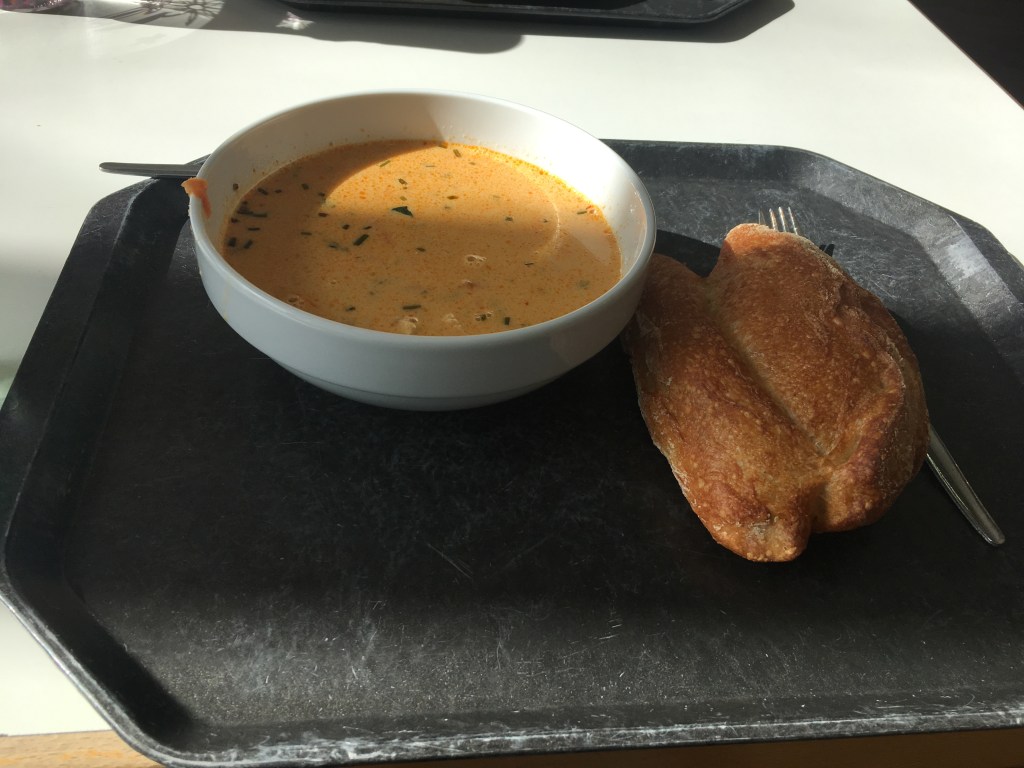
I feel like it will be the last meal in university canteen in very long time. Thai Tofu soup with bread.
After the meal I cancelled the plan to go to library and went to hamster shopping directly. My classmate said she will go back and forth to Penny (supermarket) several times. I hope she got what she needed. As I was back to Hamburg, a lot of supermarkets don’t have milk, eggs, canned vegetables, toilet paper, etc.
Before I start “hamstering”, I decided to get my last bubble tea before the isolation. At the cashier I asked whether the bubble costs more, the cashier thought I don’t have more money so he deleted the bubble from my order. I tried to explain that I was just asking, but the barista was already making my drink. After I drank 2/3 of it, I found some bubble at bottom. They just didn’t charge me for it. Free bubble from a barista! I will remember it if I wouldn’t have another bubble tea in my life.
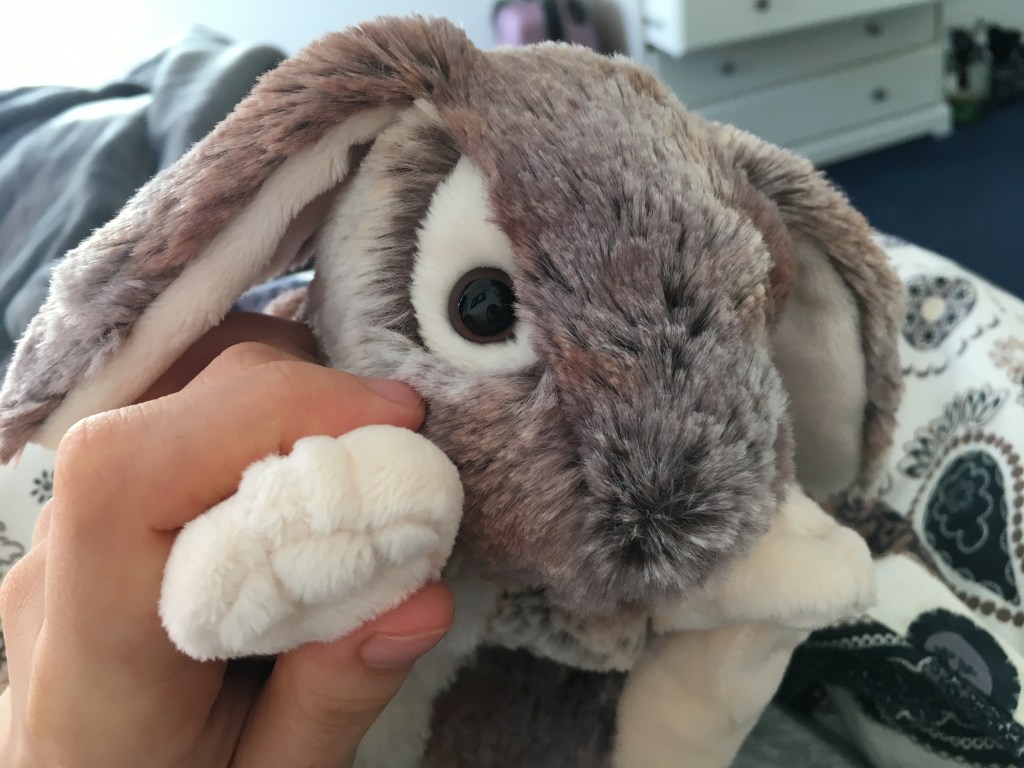
And I also bought myself a toy bunny for some mental support. It turned out that it was an excellent choice. When I was in the shopping mall it was already very empty.
Next stop: supermarket, a Penny near my place. As I mentioned above, a lot of things were sold out. But I still got something.
A German friend told me that in their sharing apartment there is 120kg of flour and they are close to a farm so they won’t be lack of bread and vegetables. I can somehow understand why my Asian friends are more panic in buying things. Because like that friend and my landlord, they have regularly a lot of storage at home. But if you live alone and/ or move place frequently, and/ or often too busy to cook, it’s more likely you just have the food for some days.
When I was home, I checked my storage, it’s ok. And I found it’s urgent to cook my 1-kg potato and a package of Pak Choi which will go bad soon. So that’s something I ate at least once for 4 days.
It’s still not officially quarantine time neither in Hamburg nor Lower Sachsen. But I thought it’s time to start at least non-strict quarantine.
I planned to learn German everyday in morning and work in library in the whole month, but now it’s clear that the plan won’t be executed as expected. How will my work going? It’s not something totally under my control now. I sent an application which has deadline on 15.03, and felt like the weekend would be a real work-free weekend.
People are panicking Because of Corona Virus Comparing with death Young people panic more That even it’s cured The patient will lose 10%-30% lung function
But you Lose about 30% hearing ability by age 40-50 About 50% taste buds by age 50-60 And probably You already lost more than 30% of your eye sight in your elementary school
We got chronic stomach problem Migraine Rhinitis Urinary Tract Infection Herpes
We learned through age How to get alone with our body parts Which are not fully functioning And we are quicker and quicker To get use to a new change
Death is not a moment It is a long process since we are born Every moment we lose something Aging It means slowly being damaged
And think of “disable” people They are just with some body parts different from the majority But everyone may have a special body part I, have a heart with abnormal vessels It means higher risk Of getting heart attack I believe we are all at somewhere of a spectrum of disability
And we are at somewhere of a spectrum Of death
The loss of part of lung function Will accelerate your speed to approach death But a lot of other things Doing the same
So why fear I’m not saying we should just catch any disease A sudden acceleration is pain And big trouble for others
But thinking of your life Don’t forget You are always slowly dying
Why fear Compare this moment with your past Are you regret Are you in a good direction Are you happier than before
To grow up Is to lose But your experience Make them worth
This is a project to improve the mental health of all musicians, composers, writers and performers during the quarantine time because of Covid-19 and to show their creativity and solidarity.
• It is an Open Source Project composed/ performed/produced by the internet music community (all materials can be re-contextualized and combined) • All contributors are free to use the material others provided • All contributors are invited to perform as well • Performance length of a single contribution is recommended not to be longer than a minute • For practical and thematic reasons, performers are asked to exclusively wear pajamas or other sleepwear during online performances
How to Participate:
• All contributors are asked to write or perform pieces, poems, miniatures etc. that depict something that they would send into outer space to show what they hold dear on this planet • Send a personal message to a contributor for upload and access – or just post your contribution with the hashtag #pajamaopera on the social media platform of your choice and let us know at pajamaoperachallenge@gmx.net or in the Facebook group. • Every composer and writer can contribute new materials or change/ remix existing materials. The materials can be traditional scores in PDF and Midi format, graphic/audio/ animated scores, texts as script or performance instruction or as lyrical inspiration, audio or video files up to 10 MB • All compositions which need performer(s) can be played with live-stream by any participant. If there is only one performer, they can organize the performance on any platform; if there are two or more performers, we will play together in the Skype group. • All materials will be preserved in a shared cloud in order to be further composed; live-stream will be preserved as audio and video recording. On this page you will also be able to watch some of the current results. • We will compose, perform, remix each other’s pieces and find the connection through them. The performer should try to show their understanding of the connection through their performance. • There will not be a final result, but we will try to present as many contributions together as possible.
DE:
#pajamaopera ist ein interdisziplinäres Format auf Open Source-Basis, das von der Internet-Musik-Community komponiert, aufgeführt und produziert wird. Gegründet von Dong Zhou und Thies Mynther am 16.3 2020 als Reaktion auf den Shutdown aufgrund von Covid-19, hat diese Plattform bereits ein reges Eigenleben entwickelt.
In Skypegruppen, Zoom Performances und über Kollaborationen auf Social-Media-Kanälen wird nicht nur über die spezifischen Probleme musikalischer Interaktion debattiert, sie wird auch ganz praktisch ausgeübt.
Die freie und offene Gruppe, die sich seit kurzem auch in einer schnell wachsenden Facebook-Gruppe austauscht, will zur Linderung der psychischen Belastung aller Musiker, Komponisten, Autoren und Performer während der Quarantäne und in der Zeit danach beitragen.
Es geht darum, eine Plattform bereitzustellen, in der Kreativität und Solidarität die Basis mittels ein paar einfacher, aber nicht absoluter Regeln bilden.
Alle Teilnehmer komponieren, spielen und remixen die Stücke der anderen und entwickeln so neue Verbindungen von Material und Mitwirkenden. Nachdem immer mehr Menschen verschiedene Stücke auf ihre Weise kombiniert haben, wird es mehrere Versionen der Timeline dieser viralen „Oper“ geben. Anstelle eines monolitischen Endergebnisses suchen wir nach multiplen Perspektiven von verschiedenen Teilnehmern, eine Vielfalt, die aus mehreren parallelen Universen besteht.
MUWA is the abbreviation of the Museum of Perception in Graz, Austria. The MUWA building was built in 1904 as a public bath. Please feel free to play with the water at the entrance and listen to the sound of our imaginary bath.
Photo: ALMAT
The installation provides several objects
including sponge, soft bottle, mini basket and popping candy for the audience
to play with the water in a bowl. The sounds are collected through a contact
microphone and sent to a Pure Data patch. There the sounds are processed and
played back with the original public bath acoustic.
Some words about personalization, communication and how I place myself when creating the project “Soundra Massage”
Things started from my tinnitus.
It is something really draws a lot of attention of a musician, so I kept asking “am I having tinnitus now, or is there a noise in the environment?” It is annoying. Not only because it made me worry about losing the audible ability, but also because the sound I paid a lot of attention to, doesn’t exist for other people. I may look anxious, but it’s hard to let other people know the reason. When I have tinnitus, I’m actually having a sound source which I can’t share its sound with other people.
Personalization
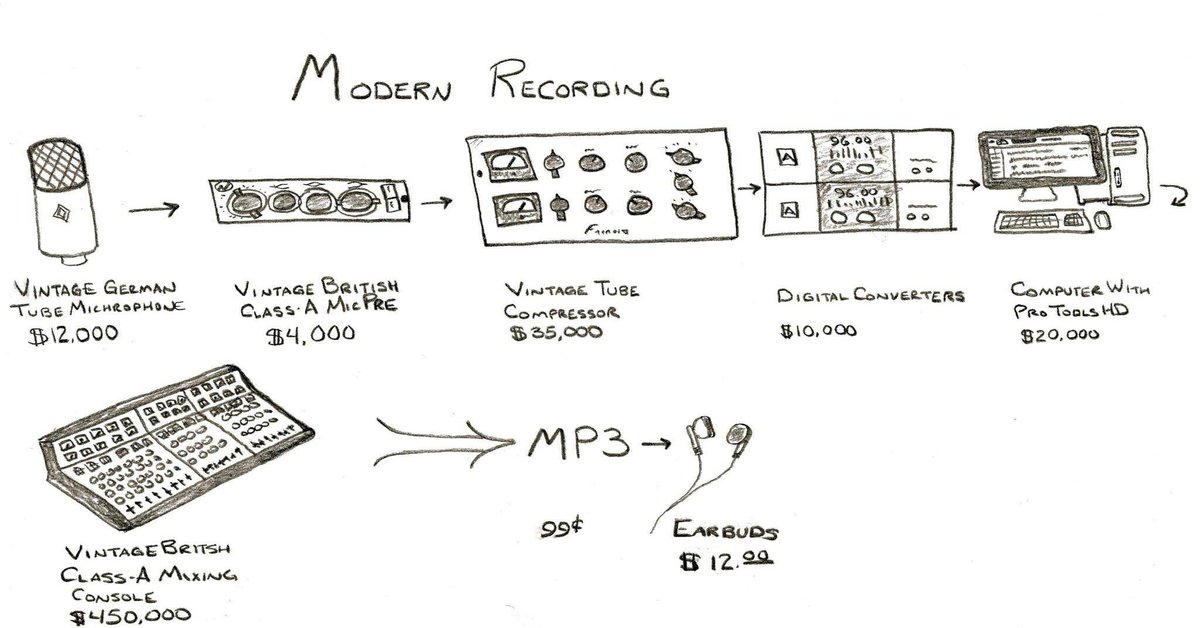
But that explained something I confused for a long time. As a composer who once learnt music production, I always have the doubt: does it make sense to make all mixing/ mastering environments the same? A lot of producers are trying to build a very dry studio, buy the “standard” monitors, calibrate every time before starting a project; they also require their audience to use some “professional” playback devices to play their works. There is a famous picture which is regarded as a joke or a meme on the internet telling about the real situation (which made these producers very angry):
picture from internet
Of course, they changed their mind somehow
after knowing the cruel reality: in some studios, they do several versions for
different sale channels – one for CD in shops, one for internet downloading,
one for mobile app streaming, etc. There are some producers even tried to know beforehand
which device their customers are using, especially the device of the person who
decides whether to pay for the production. They make a special version for this
person, then they are more likely to have time to show and explain their “studio
version”.
But since the audience is using thousands of different devices, plus the different physical conditions and different listening environments, what these producers doing is just trying to reduce the audible differences between every single person (but never eliminate it). Of course, it makes sense for huge productions like pop songs, but is it too egoistic if you’re facing a small audience no more than 50 people?
Communication
This is exactly the situation of many
contemporary music works. A bigger audience is not the priority among the
reasons composers creating their works, deeper connection with the limited
audience seems much more important. In this case, making music works more
specific for some groups is a very effective strategy. Thus, we’re seeing
pieces for children, for patients, for a place, for a certain period of time…
But there must be some sounds only YOU want to listen/ make/ share.
Composers usually can’t take care of these
needs, because traditionally they’re supposed to “express themselves”. We
always say we’re going to “show” a piece, sometimes we say “share” too, but it
still means “share the sounds/ images came from my mind”, or at least “let me
show you my feeling first”. If we just think music is an art, it is reasonable to
worship it. But if we go back to the start point of music – communication, this
composer-dominant situation can’t make me satisfied.
There are pieces which audience can fully freely
participant, but even though, in most works I’ve seen, I can’t say the audience
is at the same position as the composer. Because the composer is not really listening
to the audience, he/ she/ they won’t change their piece after knowing the
audience’s needs, like the producers making a special version for the most
important customer. The audience is always ready to pay attention to the
composer, but the composer is not supposed to know every audience’s idea, no
matter how small the audience is.
Is it communication? If the equal status is a precondition of communication, if exchanging ideas is the essence of communication, I can’t admit the “mainstream” composition and musical performance nowadays is a way of communication.
How I place myself here
When I was a teenager, one of my biggest wishes
is, me not being a composer. It was because I was strongly influenced by the
communist thoughts and I thought it’s very important to serve the people, but
not to make myself prominent. Later I also learnt about the value of being an
individual, and I started to accept myself as a composer. But I’m still happy
to provide some services to people, as a composer-performer.
The title “Soundra Massage” is a combination of “Tantra Massage” and sound. Like tantra massage through some intimate sessions to help people explore their sexual pleasure, Soundra Massage is a personalized, therapy-like, one-to-one process to explore the sound possibilities of the audience. The session will happen in a bed where the audience can be relax, no other observer or assistant is allowed. It will start with a talk, so every session will be different from each other. I may play some pieces by other composers with my alternation to warm up, then play 1-3 my improvisational pieces (specially composed for this project) together with the audience. Some parts can be multi-sensory, but it will be centered by sound.
In different situations, I have different
relationships to the audience. But in this project, I will try to be at totally
the same position as the audience (could be lower sometimes), try not to show
off the characters or skills of a composer. It’s an attempt to dissolve the boundaries
between people, art and environment, like some artists already did decades ago,
but still something worth trying now in the sound area.
This thesis focuses on multimedia art works presented in multiple spaces. Multimedia technology is not only used as an aid to connect these spaces musically but also part of the dramaturgy, which constructs the narrativity. The narrativity here is not referred to traditional story-telling through the timeline, but on a more abstract level, sometimes understood as a statement. Meanwhile, different spaces are also used to create different aspects of the narrativity, which break the limitation of the timeline but can still present the concrete plots clearly.
Music can be played everywhere, as long as the performers and the audience can perceive it properly. The Answering Phrase (Dui Ge) of southwest China and Taiwan is an early example that people singing on different hills, listening and answering each other.[1]
Composed music pieces are usually presented in one space, which is the easiest way to let performers synchronize and the audience to listen to it. Charles Ives’s “The Unanswered Question” (1935) is a nearly attempt to explore the possibility of multi-space presentation. The intention of it was purely acoustic. But it reminded composers, that one space is not the only way to present a piece, Gabrieli had his experiments in 16thcentury. [2]
Since 1979 (the year which Walkman invented), the development of technology and the faster, higher-moving lifestyle made music not necessarily related to places anymore. People do not have to go to a concert hall to listen to music. And because they can, and they need, they started bringing music everywhere with their portable devices. “The dispersal of place, as a locatable point, in turn, parallels the increased dispersal of the sound event.”[3]
Mobile phone and streaming video pushed this idea further. “The idea of using communication system to transport sound to multiple locations breaks apart the sound event by infusing it with geographic difference…it inaugurates a new kind of orality and audition by mobilizing both, beyond the strict spatiality of the local.”[4] Not only listening but performing, became possible anywhere. Especially after electronic music and sound installations are well-accepted as music forms, the audience can enjoy music without the presence of human performers as well as with it. Performers making sound in front of the audience is no longer an essential condition for audience to enjoy a music piece.
Multimedia art works can be combined (but not limited by) of music, video and technology. There are many examples of multimedia works presented in two or more spaces at the same time. I will look at three of them, as well as two non-music examples to explore the use of multiple spaces and the results of it. Under such a circumstance, I composed the alternative opera ChatROM in 2018. I will write about this piece in the end, and try to answer this question: is the multi-space performance only a new way of presentation, or it has also its content? Marshall McLuhan once said: “The medium is the message.” Therefore, this way of presentation must bring its meaning, or at least let the expression of certain ideas easier.
Figure 1: CD cover of the published version of the piece.
Chrystal Psalms is a concerto played on October20, 1988 on the victims of the Nazi pogrom of 1938. It was composed for musicians in six nations, simultaneously performed, mixed and broadcast live in stereo to listeners from Palermo to Helsinki. This event was recorded and remixed in 1991 and was published as a CD.
“The score was composed to be played by complementary ensembles in each of the six locations. These consisted of: a mixed chorus (16-32 voices), a quartet of strings or winds, a percussionist and accordionist. While each group of musicians was conducted independently, are corded time track — heard by each conductor — was used to synchronize all six ensembles.”[5]
The technology used here is quite simple: broadcasting. And it seems like this piece can also be performed in one place, the musical result may not be very different, or sounds even more fluently. So,why did he choose this way of performing? What is the message it carried?
Imaging sitting in a room, looking at the conductor for your music group, but you know what you play and what you hear is only part of the whole picture, how was the mental status different from playing with all the instrumentalists in one room? Curious, disturbed, nervous,incomplete… “This wasn’t just a stunt: there are moments of difficulty and non-communication that make the overall flow still more moving.”[6] It conveyed the idea of collaboration and embracing each other, even it is difficult, even though the result may not be perfect.
Yet the audience sitting in front of radio may not receive all the information while listening, the event as part of the process to create the sound, is an important of the piece. The imagination of the process, for the radio listeners is also part of the piece. “Alvin Curran’s Crystal Psalms isn’t music.”[7] this comment can be found in a classical music magazine in 1995. But viewing this piece now, I would say music is not only an audible material here, but also an evidence to convince the audience that the process, the collaboration really existed. And its role as the evidence is probably more important. With more witnesses, the musical statement of the piece could spread wider. And without remembering and learning there is no survival.”[8]
Orpheus Kristall is an opera in two media, premiered in 2002 in Munich, Germany. New York, Berkeley and Amsterdam. It lasts 80 minutes. The instrumentation is baritone, 3 sopranos, various percussions, flute, clarinet, 2 trombones, string orchestra and “network ensemble”. The network ensemble played in different places of the world, while the other musicians and audience were placed in the hall in Munich.
It showed an autistic Orpheus (baritone) is lost in the complexity of a multimedia opera. “He reacts to incoming sounds that emerge from the Internet to get to know and locate himself in this media-world, until three imaginary Eurydice characters appear on stage and confront him and his hallucinations of the most traumatic event in his life: the [loss of] his Eurydice.”[9] There is narrativity here, but it is not the traditional linear story-telling. “This opera does not tell a story. The story is rather pushed far behind; only an echo of the story remains to be heard.” [10]
Stahnke considers, however, at least two distinct possible story lines. First, the classic story of Orpheus: Orpheus descends to the underworld of “Hades” to retrieve his beloved Eurydice; he fails, and eventually collapses. Second, a transformation of the Orpheus myth: he escapes from the underworld, but Eurydice seduces him when she realizes that she would no longer be able to have contact with Orpheus.[11]
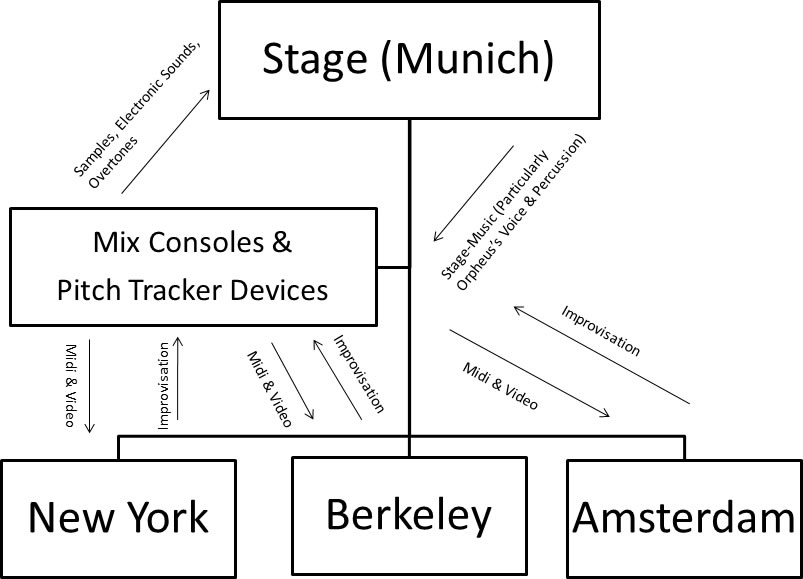
Unlike Chrystal Psalms, the players of the network ensemble don’t play a score with detailed notes. Instead of it, they improvised with the interactive networked multimedia performance environment invented and developed by composer and computer musician Georg Hajdu. It enables up to five performers to play music over the Internet under the control of a “conductor.” The players interact over the Internet or local networks by exchanging musical streams (control messages)via the Quintet.net server. On the server,the streams get multiplied, processed by algorithms, and sent back to the clients as well as to the listeners.[12] At the terminal computers, the control messages trigger the samplers and sound banks installed there. The input of their improvisation is the performance happening in Munich which were video-streamed to every place. The baritone’s voice was also transmitted to there as MIDI notes shown on the interface of Quintet.net.
Figure 2: The Function of the Internet in Orpheus Kristall (Navid Bargrizan).
Stahnke used a microtonal scale which divides an octave to 53 tones as well as other microtonal materials throughout the whole piece. In order to make the electronics sound “in tune”, there was a microtonal filter adjusting the MIDI notes to the harmonies given in the score. There was also a spectral filter in Munich which detected the spectrum of baritone’s voice. The spectrum filter first detects its frequencies with the Max object“fiddle~” and then turn them into MIDI numbers. The spectrum filter was used to filter the processed performance by the remote musicians (multiplied by applying MIDI delay and pitch shift) through the spectrum and thus achieving a kind of eerie vocoder effect.
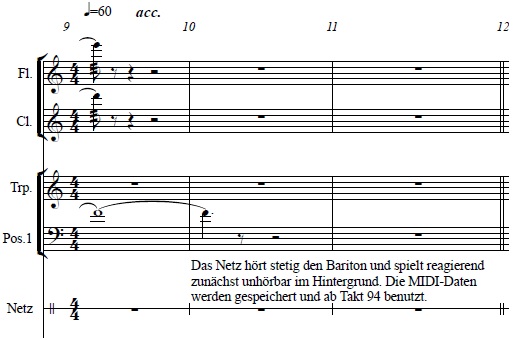
The performance was also streamed via a real stream to the remote locations and the Internet audience. It is an important fact that in 2002, the bandwidth was still under 2 M bit/s. So, there was always a 40-second delay. What the players heard and saw was always past for a while, they were answering to the baritone on stage, but not only indifferent geographic spaces, also in different time dimensions. Stahnke did not just “accepted the technical deficiency” but took advantage of it in his aesthetical pursuit. In the second scene, there is a place where he demanded the network ensemble to play but not be heard. What they played was stored as MIDI information and would be used after 84 bars. This delay by intention made the “late answer” no longer a problem to be fixed, but an artistic choice made by the composer.
Figure 3: Score of Opheus Kristall, scene 2, bar 9-12, the “intentional delay”.
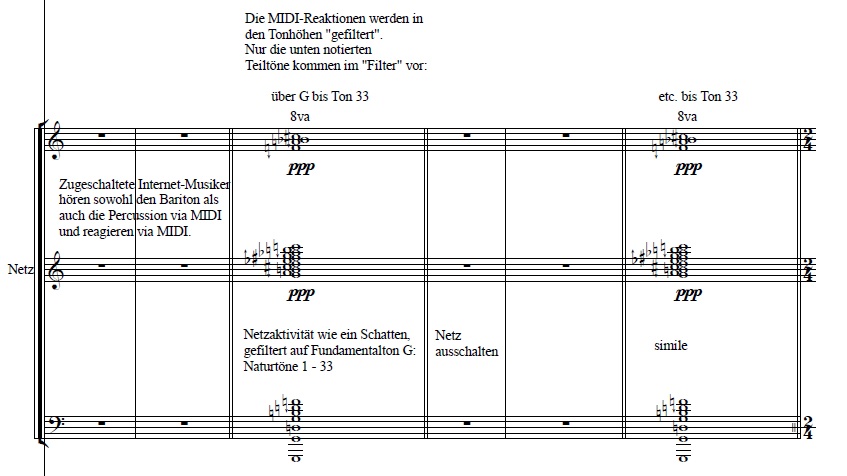
In the score, there are instructions for the network ensemble to “turn on” and “turn off” the network. As Roy Ascott said,“The individual user of networks is always potentially involved in a global net, and the world is always potentially in a state of interaction with the individual.”[13] Metaphorically, the network is like a window of the interior world, it makes the sound of the exterior world audible. Sometimes the window is opened, and people inside can feel the exterior world, but it is not so often opened. Interior and exterior world, that is Stahnke’s goal in aesthetics. “What important is to include and to discuss the ‘exterior’. The ‘exterior’ will not only produce or amplify the‘interior’, but also threaten or destroy it. Here, how should the music, word and pictures be put together?”[14]
The level of interaction between places in this case is higher than Curran’s piece because all the ensemble players can hear each other, and they can hear and see what happened (40 seconds later) on the main stage.
“The incoming sounds, reflected in the hall, leave Orpheus to deal with his memories, as they leave us to question our existence through the opera’s content. The opera seeks to break the barrier between interior and exteriors realm—to overcome the old “Kristall” of equal temperament, and the immediate stage. Breaking the barrier between the exteriors is the Internet’s role in this production, an allegorical mediation between technology, the opera, and its message. Here, the internet mediates the projection of the autistic Orpheus’ thoughts (voice), attempting to come to terms with his memories. The remote musicians react to his thoughts and improvise. The irreflections flow back to the stage through the media of Internet, and Orpheus,now confronted with them, keeps trying; and that is how this interaction begins to exist.”[15]
Figure 4: Score of Opheus Kristall, scene 1, bar 11-16. Instructions about turn on, turn off and the filter can be found.
While reading Stahnke’s concept about the piece, I also thought an alternative to place the network ensemble in boxes in the same location as the singers and instrumentalists and to fake the connection as it is between different places, like Muntendorf did in 2016. That could make the technical setting much easier and more stable and have almost the same result for audience. But would it be “same”? For people living in our time, it is reasonable to think the sound from loudspeakers are triggered from a long distance. But in 2002, when the “real result” had never been achieved,the audience could hardly image how the network music was played remotely. Within this background, Opheus Kristall should be really performed in different places to give the audience a feeling of “sound from external world”.
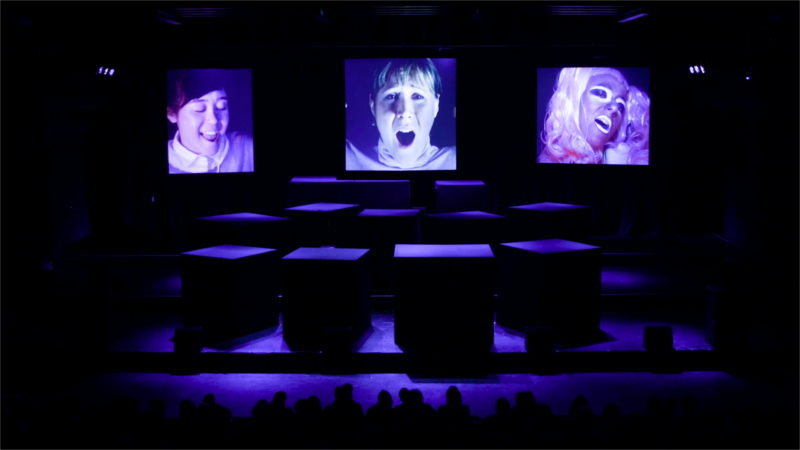
iScreen,YouScream! Is a social media opera for Ensemble (flute,clarinet, saxophone, synthesizer, percussion, trombone, violin, viola, cello, conductor), actor, live video and electronics. It was premiered in 2017 in Stuttgart. All 11 performers were in 11 black boxes on stage respectively, a cameraman walked around went into each box and projected them on 3 screens real-time.
It is written in the program note: “Looking at a stage set consisting of black boxes, I ask myself how I can be sure that 9musicians, an actress and a conductor are really there. And if the aforementioned truly are hidden within these boxes, I have to ask myself how they can communicate with each other…indirect, like always. Through screens,through audio, through monitor and through click track.”[16]
This piece is written in the era that technology developed to a totally new level. We can easily transmit any kind of data (text, code, audio and video, etc.) in the same room high-quality and without noticeable delay; and with some effort, we can also manage to transmit most of data for artistic purpose among several different places with acceptable delay and loss of quality. In this case, the way of interaction depends mostly on the composer. Muntendorf could let the musicians interact with each other to a deeper extent (e.g. improvise based on each other’s playing, talking…), but here what she set among the musicians, was very similar to what Curran did 20years ago. Screens, audio, monitor and click track, are they really for communication, or just for synchronizing all the musicians who could not see each other directly?
Amanda Cook called it “out-put-only-method of communication” and believe it “served as a powerful statement on the current condition of in-person human interaction and companionship in the digital age”[17] Seems for audience, the sense of communication did exist.
What the audience saw, is a social-media-like conversation, and the process of how individual shows became public. They will connect with their personal experience in their daily life and put themselves at the position of the social media fans’. They feel the communication to the performers, but not necessarily the communication among performers. This sense of communication is from their acknowledgement of people living in the digital era, so it can be independent from technology used by and for the performers.
Comparing with other pieces, this piece is happening in only one location, but the performers are hidden and isolated intentionally. According to the article by the composer, “communication models” of the social media is import to what she called “social composing”. The communication models can be incorporated into the composition strategy or become part of the piece itself as the dialogue and where the dialogue took place. The camera man, the transmitting devices on stage and the performer finally came out the boxes are all process and evidence of how a social media is formed. In another word, with this way of presenting, the form and content of structure of a social media can be shown at the same time, which is no more an imitation of the real life but surely an artistic expression.
Muntendorf wrote in Social Composing: “…concert halls, as they exist now, are closed spaces, the worst possible venue for social composing concepts…The most suitable place is the net itself, preferably with a projection screen in the real world.”[18] In this piece, she reformed the concert hall to a suitable place for social composing. It seemed to be in the middle of the worst and the ideal cases, but also where the audience, who are used to go to concert hall, could still be convinced. In the end of that article she questioned: “are we ready for social composing?” In some cases, it can also be the question “are we ready for social listening”?
Inspirations of the multi-aspect,
non-linear narrativity
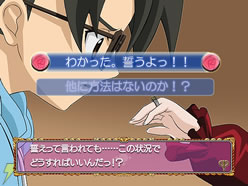
A bishōjo game (Japanese: 美少女ゲーム Hepburn: bishōjogēmu, lit. “pretty girl game”), or gal game (ギャルゲーム gyaru gēmu, often shortened to “galge”), is “a type of Japanese video game centered on interactions with attractive girls”. These games are a subgenre of dating sims targeted towards a heterosexual male audience.[19]
Bishōjo games are similar to Choose Your Own Adventure books in the way of narrative, in which the game tells a story, but the player may make choices to change how the story flows. While in the Western industries, those games can be considered visual novels, in the Japanese market bishōjo game has established its own niche unrelated to the western world.
Because they only require still character images, scrolling text and a basic program to relate them, galge provide a cheap alternative way to tell stories, outside the corporate structures and open to new (and young) creators. [20] Although it is always related to erotic content even pornography, which mentioned a lot in western research, we cannot deny that it provided a stage to show creativity with easy access. The branches and the interaction enabling users to choose them in order to influence the story are the most significant contributions to the exploration of narrativity. In most games, multiple possible stories and endings exist as an outcome. Players replay the game multiple times to “clear” the different “branches” of the story. [21]
Lynn Hershmann commented her work Deep Contact in 1990: “Interaction with virtual characters encourages the viewer to break free from the traditional audience role of passive recipient by navigating through the work’s many branching narrative paths.”[22] Looking at it today, nothing inherited her concept more like bishōjo games.
It is very likely that many features of bishōjo games came from contemporary art. But because of its independent development in East Asia and its extremely entertaining market position, I seldom see any reverse influence on the art field.
The fans of bishōjo games “Otaku” are also a huge part of “Hikikomori (isolated people hiding at home)” phenomenon in Japan. This scene, happening at the closest place to technological dystopia, can also be interesting for multimedia artists to introduce in their pieces. It might be worth for the audience still living in the relatively idyllic part of the world to think/reflect about/on this.
Finally, the erotic attribute of bishōjo games is also a reason I chose it as one of my inputs. Since its main target group is heterosexual male (sometimes heterosexual female is also considered as a second target group) and its cultural background, gender-based violence, discriminatory gender stereotypes and other kinds of heterosexual ideologies are easily found. The distributor of RapeLay claimed: “the game was approved by Japanese regulations and we will not accept this kind of criticism from groups located on the other side of the world”[23] to answer the statement of European Women’s Lobby (EWL) showed their attitude. But if bishōjo game could influence contemporary art reversely and not only keep its position as a fast-moving entertaining product, their creators should consider as much as artists do and should face to all kinds of people but not only Japanese heterosexual group.
According to thedramateacher.com, “promenade theatre normally involves outdoor performances in public places, such as city laneways or town streets. Multiple locations for staging is common (though ‘stages’ as such, are not), with the audience asked to move throughout the performance and follow the action as it progresses. It often blurs the physical space between performer and spectator, sometimes seeing actors deliberately performing in and around the audience.”[24] Since last decade, we can find these kinds of characters in multimedia art works as well. There are some similarities between these two categories of art, interactivity between audience and performers and the immersive environment created by artists are the two most significant ones. But they had different strategies through their development.
Multimedia composers tend to create the environment from nothing. Sensors are their tool. They are used for creating new instruments, and the new instruments help to increase the interactivity between musician and electronic music. Building new instruments does not only mean making instruments such as the “hyper-instruments” pioneered by Tod Machover and STEIM; but also common things in daily life such as cameras and game controllers became musical instruments, and they do not require the users to have much music background or practice time. They afford the audience with the ability to also perform and thus turned the interaction between musician and audience into a popular theme of the multimedia discourse, beyond the mere use of sensors.
On the other hand, the condition of composing electronic music evolves constantly. Sound diffusion moved from mono to stereo to octophonic, different formats of Dolby surround systems to wave field synthesis…Respective recording equipment and digital audio workstation followed the trend tightly. In recent years, augmented reality and virtual reality became also popular composition tools for multimedia composers. All these technologies allow composers to create a world which mimics the real world, but is never the same.
Theater producers have a different approach. They started from using what already exists in the environment, or with the audience — historical in nature and site-specific non-traditional theatre spaces… But composers have also noticed the potential of the “existing materials” in their surroundings. Here is a famous dialogue recorded by Michael White in 1995:
“I know it’s hot,” I said,
“but can we close the windows? It’s so noisy.”
“You call it noise,” said Cage. “I call it music.”[25]
Influenced by Thoreau’s thought, Chinese and Indian philosophy, John Cage appreciated the sound from nature very much. The most famous work of him, 4’33’’ presents this concept very well. It included all the sounds in the concert place as part of the piece.
He made this remark in a TV program, and later it was published in the journal October (1997): “I try to bring about a situation in which there is no difference between the audience and the performers. And I’m not speaking of audience participation in something designed by the composer, but rather am I speaking of the music which arises through the activity of both performers and so-called audience.”[26]
From another set of pieces: 33 1/3, Address and Cassette we could found the dominant position of the subjectivity of the “audience”. They are given phonodiscs and turntables without any instructions, the result of the piece is much related to their decisions, where the piece is played and how the loudspeakers are distributed.
More recently, Manos Tsangaris’s “audible film” Schwalbe (2011), for soprano/moderator, bariton/moderator/jogger, horn, percussionist/ noise maker,1 großes Nebelhorn, “gestaffelte” fixed media/live-amplification, amateur actors in harbor and moving audience used the movement of a ship and the space on its routine. It is comparable with Ferry Play (2015) by This-is-not-a-theater Company, but it came even 4 years earlier than the famous promenade theater. His City Piece (2016) for singer, actor,ensemble, installation, light, video and audio which happened in a café and the gallery opposite to it can also be related to the Café Play (2018) by the same produce group.
ChatROM (Libretto in addendum) is an alternative opera performed in two rooms (HfMT Forum as the main hall and ELA1 as the smaller room) at the same time, about Anime, gender and the life in post-digital era. The instrumentation is: soprano, keyboard, electric bass, flute, cello, drum pad and a non-musical actor. The duration of the piece is about one hour. The story is between a lesbian animation fan (Web name: 404) and a transgender cosplayer (Web name: Sachiko). They meet in an Internet chatroom and start rethinking their identity because of the encounter.
The story shows the chances and challenges in the post-digital era for lesbian and transgender people. The modern technology gives us the possibility to find friends all over the world and to keep anonymous, while the problems, discrimination from the old days are still there. It is a portrait of two lonely people keeping their lifestyles under the protection of the internet and trying to accept themselves and to live in a wilder world.
Apparently, it is a story happening in two rooms. But after seeing the successful presentation of pieces like “iScreen, YouScream!” which “fakes” several rooms in one space, why I still need 2 geometrical rooms?
First it is for presenting two completed characters. I hope the audience can feel the two roles equally. Sachiko is a virtual character, but for 404 she is real. And in most of games, the characters are based on reality. Sachiko should also be a complete character. She and 404 have different levels of understanding and requirements of “being a woman”, which makes them two individualities confronting each other, but at the same time, complementing each other.
In many classical literatures including heterosexual love stories , from Greek myths to Chinese “Four Great Classical Novels”, usually the male and female protagonists are respectively the “subject” and the “object”. The subject takes the action, and the object accept it, in reverse sometimes, but the subject is always leading the change of the whole picture. This tradition appeared in homosexual stories in Japanese comics too. The characters,especially in gay (Boy’s Love) stories, are usually divided by “Seme” (butch) and “Uke” (femme). The interaction between Seme and Uke mimics the male and female characters in old time. But the real life is not like that. The audience should witness, that the both women have their own life and take their own actions.
Another reason is that I want to introduce the internet streaming as a phenomenon. In 2015-2017 the Internet streaming became a trend in Asia, especially in China. It is different from YouTube channel or any other self-media, where the anchors must provide interesting contents.The users are so many, that the anchors do not have to show any special skills on the screen to attract the viewers. I feel it is impressive, that some people showing only their daily life (eating, doing farm work, doing housework,chatting…) in chatrooms, have a lot of fans. The viewers are not perverts, a lot of them just let the video run, and at the same time doing something else. They just want the feeling that they are not alone.
Because of the strong need, Internet anchor became a popular part-time job. Some people can even live of it as a full-time job. Their working conditions are also interesting for me.
Like with all the self-media makers, they must be actors, directors, camera man, make-up artist, PR and security for themselves. But because of the content is much more personal, they must find a balance between personal life and their program. Sometimes they must create another character – with cosmetics, filming angle tricks, background cover… I used many of these elements to show the life of an internet anchor. Webcam stander,photo with low resolution on the background, chaotic cables on the floor… These objects can speak themselves. Allowing the audience to enter a room of an Internet anchor, is also part of the dramaturgy.
Another reason for this setting is for showing the life online and offline. What we present online can be different from what we do offline, but Internet identities are no longer limited by their physical features and social backgrounds. Some people maintain this difference because they want to be “real”; some people for feeling better; also, some people for earning money… But the creation of every online “character” is always motivated by reasons and stories from offline life. I hope the audience can feel this point by moving from different spaces.
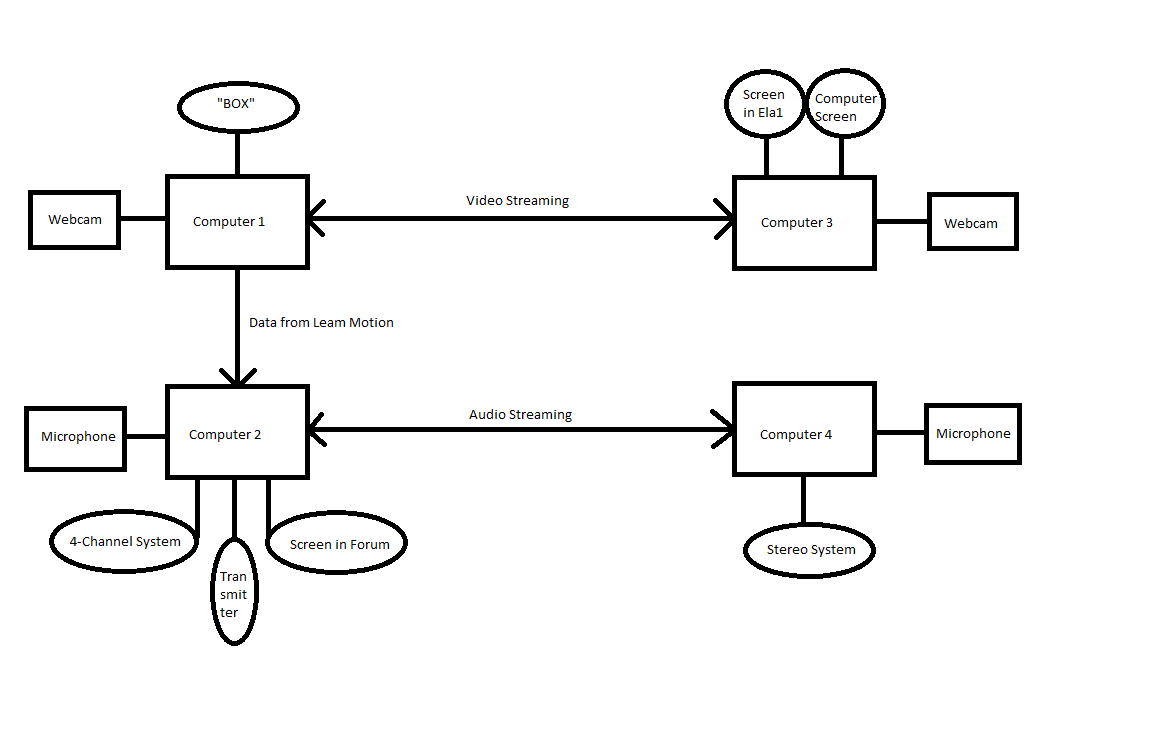
With the two rooms (Forum and ELA1), I created a set-up with 4 computers and some other necessary equipment. The general setting can be found in following figures:
Figure 7: Technical connections in ChatROM.
Forum
Sound source
Input Audio Channel
Input Video Channel
Output Audio Channel
Output Video Channel
Detail
Computer 1 (stage)
0
1 from attached camera
0
1 to projector (small, near stage)
Need power and internet socket
No sound interface, with Leap Motion
Computer 2
(audience)
1 from the wireless mic on singer
4 to mixer (fixed media)
1 to transmitter (click track)
1 to projector(forum)
Need power and internet socket
MOTU interface
ELA1
Sound source
Input Audio Channel
Input Video Channel
Output Audio Channel
Output Video Channel
Detail
Computer 3
0
1 from Logic Webcam
0
2
to projector (ELA1) and to the computer screen
Computer 4
1 from the wireless mic on actor
2 to loudspeakers
RME Babyface interface
The technology here formed the “space”. Some of them simulated the reality:
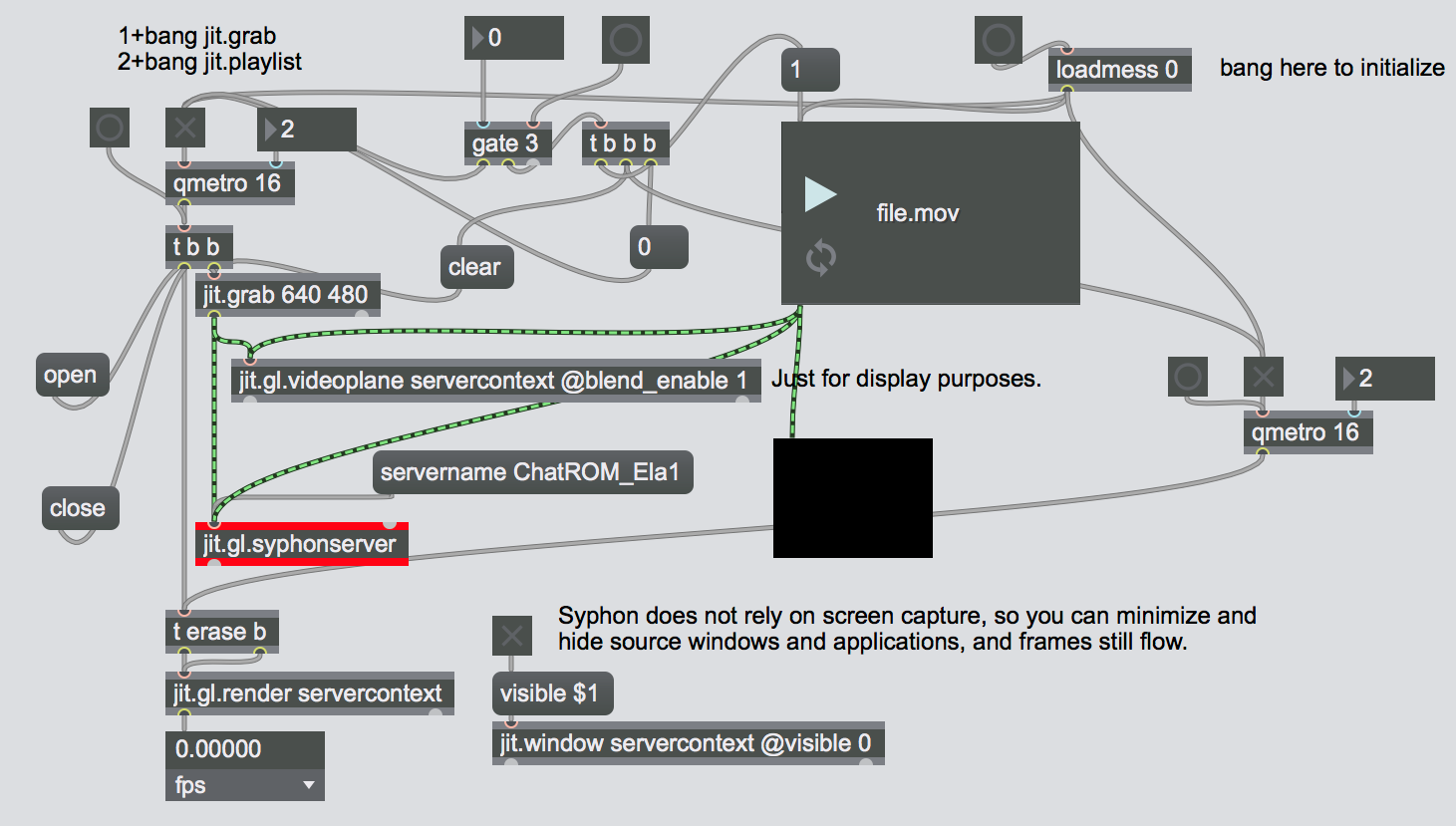
The video streaming inside Max is a simulation of video chatting, which is an important visual element throughout the whole piece.
Figure 8: The Max patch of sending part of the video.
Syphon is an open source Mac OS X technology that allows applications to share frames, full frame rate video or stills, with one another in real-time. Now you can leverage the expressive power of a plethora of tools to mix, mash, edit, sample, texture-map, synthesize, and present your imagery using the best tool for each part of the job. Syphon gives you flexibility to break out of single-app solutions and mix creative applications to suit your needs.
For audible part I used Soundflower to send audio stream from Skype to Max. In Max I can edit the sound further.
Soundflower is a MacOS system extension that allows applications to pass audio to other applications.
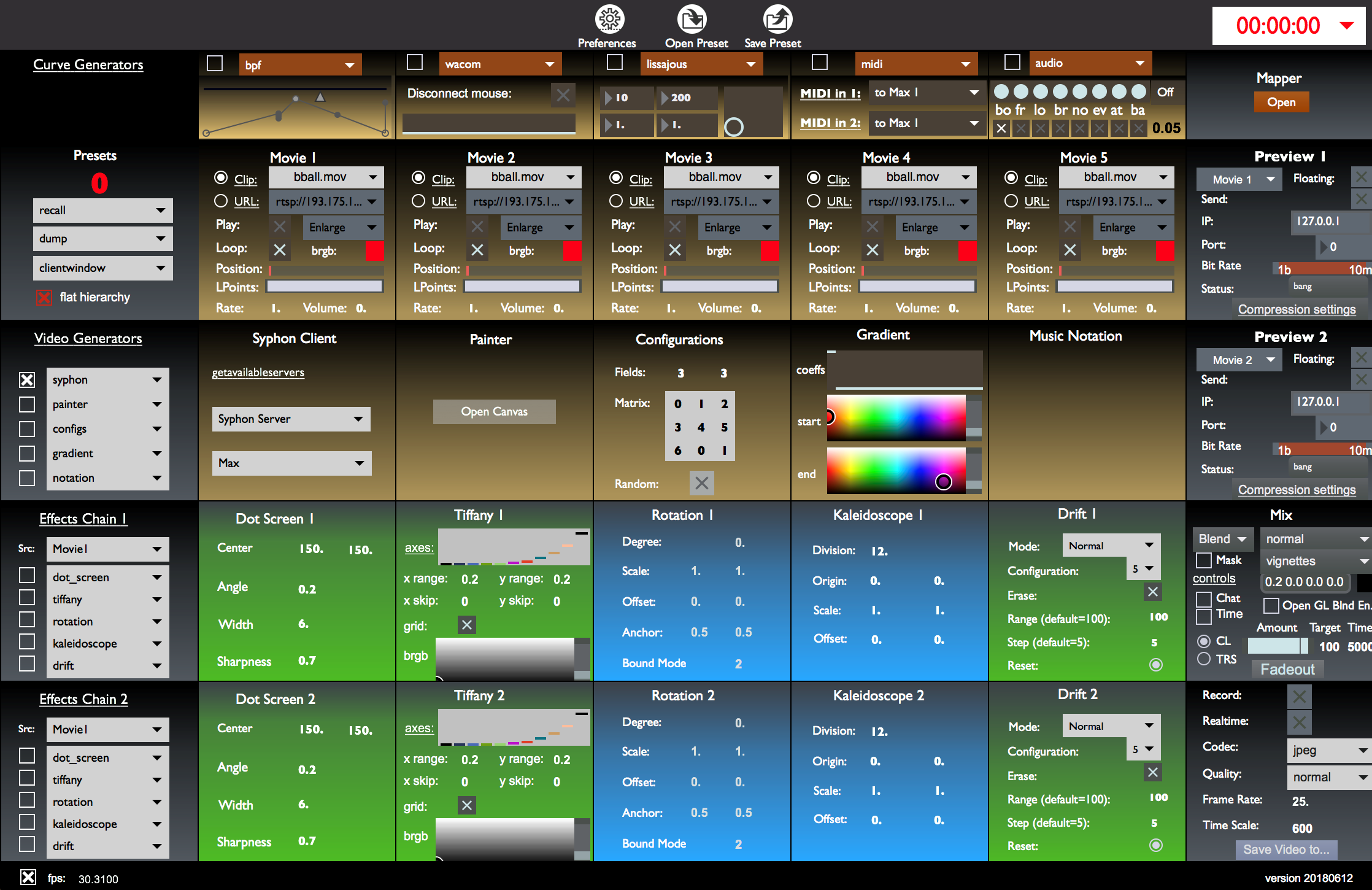
And there are also technologies used for making the reality I created again unfamiliar. Visually what most noticeable is the effects added on the streamed video from Syphon.
Quitet.net Viewer allows the realization of full-fledged multimedia pieces by taking advantage in a modular environment of the Jitter video processing capabilities. Thus, users can easily add new processes.
Figure 9: The interface of Quintet.net Viewer.
Quintet.net is on the receiving side of the video stream. The program can also add different live effects to it. I have set 9 presets and the interpreter (singer in Forum) can change them in real-time. It is a hint that 404 is controlling the whole story.
For the sound I also made two extra parts to add some mysterious colors to the piece. The first one is the sampler function of Quintet.net, which makes it possible that people in two spaces to get her improvise with samplers. Sachiko played a computer keyboard in her room, and meanwhile people in Forum can listen what she’s playing.
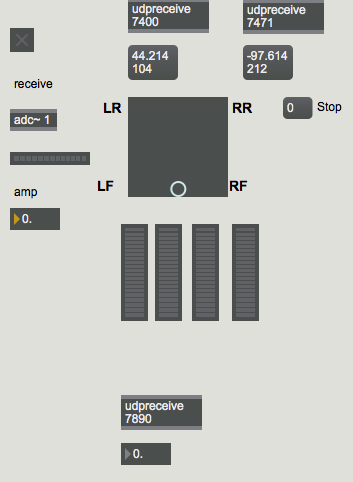
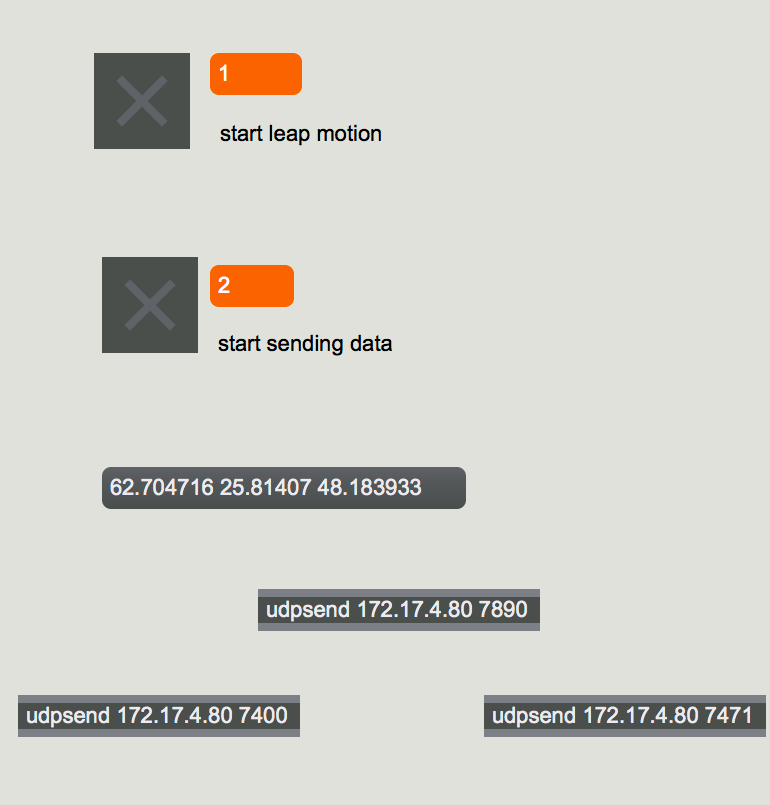
The second is a Leap Motion used to track the right-hand movement of the singer. It is another hint to the truth which would be revealed in the end of the story.
Figure 10: The Max patch of the receiving side of Leap Motion.
Figure 11: The Max patch of the sending side of Leap Motion.
The Leap Motion controller is a small USB peripheral device which is designed to be placed on a physical desktop, facing upward. It can also be mounted onto a virtual reality headset. Using two monochromatic IR cameras and three infrared LEDs, the device observes a roughly hemispherical area, to a distance of about1 meter. The LEDs generate pattern-less IR light and the cameras generate almost 200 frames per second of reflected data.
404 can spatialize Sachiko’s voice with Leap Motion. The data of her hand position was sent to the Sound Computer through UDP protocol. 4-channel sound spacialization and reverb are applied to the streamed voice.
Multimedia art works presented in different spaces objectively gave musicians more chances to practice their works. Pieces especially like Crystal Psalm, which involved many musicians outside of experimental music, made them noticed the possibility to use technology to change the way of producing music. For instance, today, it is very common for pop, jazz and some classical musicians to use software such as JackTrip to rehearse in different places.
But this way of presentation fits the digital era artistically as well, especially when interaction among different places became part of our daily life. It imitates and mutates our current lifestyle, just like ancient Chinese music imitating the sound of nature. As mentioned in the introduction, the idea of presenting a composed piece indifferent spaces came up with the dispersal of locations and migration through globalization, it is born with a kind of realistic poetry. Even when it is applied with a highly abstract, non-realistic concept like Orpheus Kristall, it inevitably reminds the audience their life at this moment (but not long ago). And they could take their nowadays lives as a metaphor to a story in the past or think of their lives on the same level as a myth. We don’t only use past as the reference to present, the present itself is our reference. This is the allegorical and philosophical part of research on this way of presentation.
Georg Hajdu: Embodiment and Disembodiment in Networked Music Performance in Body, Sound and Space in Music and Beyond: Multi-modal Explorations (edited by Clemens Wöllner). Routledge, 2017.
John Cage: Silence: Lectures and Writings. Wesleyan University Press, 1961.
Michael White: CLASSICAL
MUSIC : A scintillating symphony of the streets. 1995. .
John Cage and Helms: October. 1997.
Yaohua Wang, Yaxiong Du: Introduction to Chinese Traditional Music (中国传统音乐概论). Fujian Educational Publish House, 1999.
Roger Kaza: A MARRIAGE OF SOUND AND SPACE. Transcript of radio program “The Engines of Our Ingenuity”.
Ben Watson: Honesty Is Explosive!: Selected Music Journalism. Woodstock, 2010.
Navid Bargrizan: A NEW OPERA CONCEPT: ANIDENTITY QUEST MEDIATED BY DIGITAL MEDIA AND MICROTONES IN MANFRED STAHNKE’S ORPHEUS KRISTALL. 2001.
Navid Bargrizan: Aspekte mikrotonaler Komposition. MA Thesis. University of Hamburg, Hamburg, 2012.
Manfred Stahnke: Orpheusunter den ganzen Zahlen – ein Essay über Schwelle. In Melodie und Harmonie: Festschrift für Christoph Hohlfeld zum 80. Geburtstag, page183-196. Weidler, Berlin, 2002.
Lynn Hershman: The Fantasy Beyond Control (Included
in “Multimedia: From Wagner to Virtual Reality”). 1990.
Roy Ascott: Is There Love in the Telematic embrace?
(Included in “Multimedia: From Wagner to Virtual Reality”). 1990.
Manfred Stahnke:
Anmerkungen zur Internetoper Biennale München. 2002.
Amanda Cook: SPOR Festival 2017 Concludes With iScreen, YouScream! 2017.
Brigitta Muntendorf: Social Composing
(included in “POSITIONEN, Issue 108 ‘Neuer Realismus’”). 2016.
Patrick W. Galbraith: Bishōjo Games:‘Techno-Intimacy’ and the Virtually Human in Japan (included in the International Journal of Computer Game Research). 2011.
Enrique Javier Díez Gutiérrez: Video games and gender-based violence. 2014.
[1] Yaohua Wang, Yaxiong Du: Introduction to Chinese Traditional Music
[2] “The double choir lofts facing each other at St. Mark’s suggested to Gabrieli and his contemporaries an obvious ploy. They instructed the musicians to form into separate groups, and sit in different locations. While they’re at it, they might as well sing or play different music. Call and response? Of course. Echo? The echo built into such a resonant space now became part and parcel of the music. “Roger Kaza: A Marriage of Sound and Space
[9] N. Bargrizan: A NEW OPERA CONCEPT: AN IDENTITY QUEST MEDIATED BY DIGITAL MEDIA AND MICROTONES IN MANFREDSTAHNKE’S ORPHEUS KRISTALL (2001)
[10] M. Stahnke: Orpheusunter den ganzen Zahlen – ein Essay über Schwelle. In Melodie und Harmonie: Festschrift für Christoph Hohlfeld zum 80. Geburtstag, page 183-196. Weidler,Berlin, 2002.
[11] N. Bargrizan: Aspekte mikrotonaler Komposition. MA Thesis. University of Hamburg, Hamburg, 2012.
[13] Is There Love in the Telematic embrace?” (1990)
[14] Manfred Stahnke, Anmerkungen zur Internetoper Biennale München 2002: Wesentlich ist die Einbeziehung /Thematisierung eines “Außen” (in jedem Sinn, nicht nur in Form vonInternetmusiken). Dieses “Außen” wird sowohl Erzeuger / Verstärkereines vorgestellten “Innersten” als auch dessen Bedrohung /Zerstörung. Wie stehen hier Musik / Wort / Bild zueinander?
[15] N. Bargrizan: ANEW OPERA CONCEPT: AN IDENTITY QUEST MEDIATED BY DIGITAL MEDIA AND MICROTONES IN MANFRED STAHNKE’S ORPHEUS KRISTALL (2001)






 Dong Zhou