Ideally, the song lyrics (or excerpts of them) may be used as part of the visual material.
The duration of the video must be the same as the track or longer than it.
What You Will Receive
All applicants will receive the selected track as an uncompressed audio file after submission.
The audio track is provided under a Creative Commons Attribution–style license (CC BY-SA 4.0).
You are free to use, share, adapt, remix, and present the music in any context (including exhibitions, performances, online platforms, publications, and commercial projects), as long as the following credit is given: “music: Dong Zhou”.
This permission is non-exclusive and does not limit your own artistic or commercial use of the resulting visual work.
One artist per track will be selected.
Selected artists will receive €200 to realize their visual concept.
The resulting visual work will be used non-exclusively in Congee Rats concerts.
The artist will always be credited when the visuals are presented.
Copyright & Usage Rights (for selected artists)
You retain full copyright of your visual work.
By participating, you grant Dong Zhou a non-exclusive, royalty-free license to:
Present the visual work in live concerts
Use it in concert-related documentation and promotion (e.g., social media, website, aftermovies), always with visual credit
The visual work will not be sold, sublicensed, or transferred to third parties.
Artists remain free to show, publish, or further develop their visual work elsewhere.
Optional support material (sketches, references, links, videos, etc.)
Remarks
I understand 200€ is not a decent payment for a sophisticated project. I am not looking for time-consuming work; simple but personal ideas are especially welcomed.
If you have any questions, please contact: shimo.dong.zhou@gmail.com
“Außerordentliches Mitglied” Almost all my fellow composers (aged between 30 and 45) are außerordentliche Mitglieder and can’t vote because our income from GEMA hasn’t exceeded 30,000 euros in the past five years. And yes, in theory, we can vote for “Delegierten” and let them represent us, but why are we treated differently?
Scores for GEMA Many composers write scores only for GEMA. Especially in live coding, generative music, interactive systems, or fixed media, scores aren’t necessary to perform or understand our pieces. But to be recognized as “E-Musik,” we have to make them. Personally, I agree that E or U is not a good way to categorize music. But the newly proposed KUK is even worse.
Our accounts are in the minus Almost all my fellow composers and I have negative balances in our GEMA accounts—what we earn doesn’t even cover the membership fee.
We didn’t join GEMA for the money We joined GEMA to release physical media like CDs and vinyl; to prove our status as musicians to immigration authorities; because venues need GEMA information to pay us… We never expected to make money from GEMA. But we can’t avoid it either, because it’s everywhere in the German music industry.
Go to Munich to vote? I don’t understand this, and I can’t afford a trip to Munich. Even government elections can be done by post or at a local polling station—why is voting in GEMA so complicated?
“Für Nachwuchs” GEMA claims the reform is for young people (under 31). But the opinions of young people have never been considered.
Point system The KUK and its point system came out of nowhere. I’m tired of “collecting points”—it feels like we’re stuck in middle school. Most of the criteria make no sense: a piece’s value depends on where it’s performed or what language the lyrics are in, not on how much work went into it.
I don’t write orchestra pieces I’m old, unestablished, and don’t write “serious” music (at least according to GEMA). Even though this reform mainly affects classical composers, it still doesn’t work for me. I’ve been excluded from the conversation, and I don’t support a system established without diverse perspectives, by a small group that doesn’t represent today’s composers.
I earn more from Spotify than from GEMA Today, commercial music platforms are important parts of the music industry, and they are influential in music distribution. GEMA shouldn’t be against them, but should complement them, especially by taking care of legal responsibilities like copyright protection in Germany, which international companies can’t handle.
You can also protest at the meeting for “außerordendliche Mitgelieder” on the 13th if showing up there is not too humiliating for you (this one has online access).
In the summer of 2024, my father invited me to play “Er Quan Ying Yue” (The Moon Reflecting in Erquan Pool) with him. He recorded our performance and uploaded the video to Douyin, the Chinese equivalent of TikTok. Two weeks later, he was thrilled to share some surprising news with me: the video had garnered over 1,000 views. He said, “I used to dream of having another recital before I die, but organizing one is too complicated. Even if I managed it, I’d be lucky to have 300 people in the audience. But now, thanks to social media, more than 1,000 people have listened to my music. Why would I—or anyone—bother organizing a traditional concert anymore?”
I guess he was broken every time he organized a concert. It wasn’t just about the effort or the expense—it was the vulnerability of pouring himself into something and not knowing if anyone truly cared. He never minded that his performances didn’t generate income; he was even grateful that some people had spent their time with his music. It’s a privilege to have a mindset like that, but even though, the attempt to build a connection with the audience often leads to disappointment.
Not long after that, I noticed something strange in my own music streaming account. I had received around $230 from various platforms. For two years, I hadn’t checked my earnings because they were always below the minimum withdrawal threshold. Curious, I assumed that perhaps I’d gradually built a small fan base. But when I checked the data, I realized I hadn’t. Most of my tracks had only a handful of plays, except for one. That single song had been played 32,314,172 times.
At first, I felt a rush of excitement. How did this happen? Was it a sign that I’d made something truly impactful? But as I dug deeper, I realized the most likely explanation: the song had been used as background music for someone’s short video. It wasn’t that people were intentionally listening to it—they were simply scrolling past, and the algorithm kept playing it over and over.
We’ve long known that streaming platforms make individual artists less visible because users rely on algorithms instead of actively choosing tracks. It’s also no secret that these platforms pay artists very poorly, often a fraction of a cent per play.
But what frustrates me even more is the way people consume music now. It feels like music has become a low-priority backdrop for multitasking. Sure, people might spend more total time with music, but how much of that time are they truly engaged? Most of the time, it seems to fade into the background.
When I first saw the 32 million plays, I was excited for a moment. I even thought about sharing the news with my father. But knowing what truly excites him—the connection between musician and listener—I don’t think he would find any joy in this hollow achievement. The truth would only disappoint him, and I couldn’t bear to explain it all.
This year, I accomplished several things my father never thought I could: I started teaching regularly at two German colleges, got mentioned in a local newspaper for my work, and kept an independent music label running for two years. But none of these things were what he imagined.
The teaching? It’s not the stable, prestigious position he pictured—no fixed contract, no travel allowance, no office, and sometimes the students don’t even show up. The newspaper? It’s not the kind of press he respects; barely anyone reads it these days, especially people my age. For most of them, newspapers are just relics from the past. And the label? To him, the concept of releasing music independently doesn’t compute. “Don’t you need permission to release a CD?” he once asked.
My song was played 32,314,172 times, but aside from about 200 euros, it brought me nothing else. I didn’t become more famous or respected, and it didn’t make my parents proud. It made me realize that I might never make my parents happy—not because I lack achievements, but because the standards they use to measure success and happiness no longer align with the world I live in.
Like my other accomplishments this year, the 32 million plays didn’t change my life. I’m still as lost as a student sitting for an exam that keeps changing its rules. And today, I must admit: I don’t know if there’s anything truly life-changing at all.
Thee Don’t Know is the duo of Lukas Kannemann (drums, synthesizer, field recording, khaen) and Dong Zhou (violin, objects, electronics). They perform and produce noise and electroacoustic music since 2025. Currently they are experimenting with audio-visuals focussing on documentary materials of daily labor.
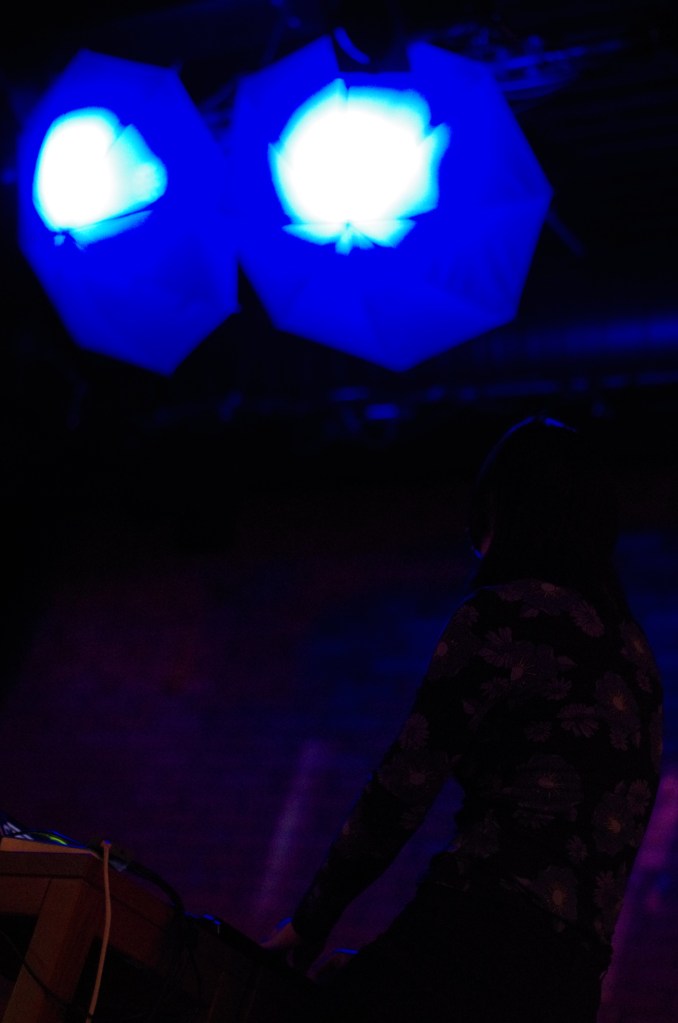
This is a performative installation with live video, light, and sound. The installation consists of two LED lights with a camera on each and can turn with a motor. It simulates the shape of a pair of huge nipples and turns nipples from an object being gazed at to a subject that can observe people. The motion of the lights and cameras reflects the fact that the nipples can change their shape during breastfeeding time, which makes babies easier to find them. The live video is an audience observation with layers of live footage. In the second half of the performance, a song will accompany the installation’s movement and send the message that the mothers give us life and save us from hunger; we appreciate them not only for what they did for us but also for what they can do.
Concept/live video/light/music: Dong Zhou Hardware design and programming: Yuguang Zhao
Premiere: 26.04.2024 at aNOther Festival in Vienna, Austria
Longest Concert was premiered in May 2022 in LICHTHOF Theater (Hamburg). With support by Stimme X e.V. Zeitgenössisches Musiktheater Norddeutschland.
Concept
The Role of the Machine
We listen to the concert. We care so much about what to listen to. But how do we listen? Where do we listen? And, with which device? Gramophone, vinyl player, transistor radio, walkman, mp3, mobile phone or computer?
Have you thought of how they feel? How would it be, to play music the whole life until got broken or replaced by newer technology?
Every device’s life is a long, long concert. Each of them has a different music style, an acoustic characteristic, advantage, and limit set by their epoch. Do you see, they all have a personality?
The history of playback devices is also the history of electronic music and the modern history of cultural activity. This piece will focus on the individuals in this history, namely, a few pieces of playback devices, and let them be the protagonists of the music theater work to tell the stories in the format change. During the change of technology, countless waste was produced. But can they have another life by telling the younger human some stories? If the offsprings know what would remain after all the updating, would they make a better choice for the planet when they develop the next product?
The Role of the Human
Two human performers will serve as the technical assistants of the devices, they move, operate, modify the devices, but they are anonymous, they don’t have a voice. It is a metaphor for the question “have we become the slave of machines”. Our perception changed by the format: a concert is around 70 minutes because CD can record 69 minutes of music; we want a break after 30 minutes because we used to change the side of a cassette after 30 minutes. But paradoxically, these standards were made by human, either for their personal taste or for marketing success.
Music
Piece 1: on the search for something yet to be lost –old radio and live-electronics
Over the course of the last 100 years, many technologies for audio listening and preservation have emerged. Many have become obsolete; some still stick around. There’s a constant discussion to shut down FM radio for good and replace it completely with the digital DAB+ alternative. However, that has yet to happen.
The piece explores the sounds of radio stations and the spaces between them to find something of value. It will search for new sounds, old sounds and blur the lines of the immediate and the past. By playing an audio file stored on a computer with a transistor radio, it creates a conversation between times.
With the help of an FM transmitter, sounds will be fed in from an external source on a specific frequency. A microphone can record the radio output, process it, and play it back again. This will create a layer of confusion between what is really live and what is played back.
The performer has multiple ways of manipulating and changing the sound. The main way is with the actual controls of the radio, the frequency wheel, switching between the frequency bands, volume control. But also by changing the length and position of the antenna, changing the position of the radio, or even moving between transmitter and radio. This will open up possibilities for creating a scenic interaction between radio and performer, seemingly melting together into one instrument.
Piece 2: hello girl – patch Bay and communication devices
Telephony was the decisional fact influencing the technologies of recording and audio transmission. The standards set by the telephone industry shaped the listing habits of several generations.
This piece will play with sounds traditionally or historically transmitted by telephone cables, including private conversation, transferred photocells (used by fax), transferred text (used by pager/FME), and 128kbps music. The typical woman image of a telephone operator (once called “hello girl” in USA) will be the main choreographic element for the performers.
It will make reference to important sound art pieces like Yao Dajun’s telephone wiretap field-recording Documentary of Beijing Sound Group XX1 (北京声音小组档案XX1), Max Neuhaus’s Public Supply, and Hannah Wilke’s Intercourse with…, an art film composed with sound materials from an answering machine.
Piece 3: arty trashy – vinyl/CD/cassette players and live-Electronics
Tape loop is one of the most popular ways to make and remake music by breaking and rebuilding its physical carrier. Inspired by this practice, we will cut, tape, paint, scratch, glue… different media like vinyl and CD-disks to construct a soundscape with multiple playback devices and the movements of modifying them.
By using vinyl and CD I am referencing the “Cut-Out(打口碟)” phenomenon in the 80s in China: western pop music was banned, but they were allowed to be imported as plastic waste if they were cut. Chinese got their early influence from western pop music within this practice. Besides its significant impact in China, it also shows that art and trash can be transferred to each other in specific historical context.
Piece 4: babel tower – SuperCollider and choir of playback devices
SuperCollider is an environment and programming language originally released in 1996 by James McCartney for real-time audio synthesis and algorithmic composition. Since then it has been evolving into a system used and further developed by both scientists and artists working with sound. It came from and through the history of network music and has most of the typical characteristics of it: different locations connected with the internet, data exchanging, audio results on local machine…
In this piece, a Supercollider concert will be played through different devices. Each device play a different voice or a different combination of the voices and they will be found by the performers from many corners. The performers will pile them up like a tower, while visually the “sculpture” becomes higher and higher, the music will have more and more voices and finally sound like a choir.
This image could stand for the power of communication or the ambition of humans to take control over the world by developing technology. It will be a quasi-religious ritual, questioning the position of today’s music listeners.
Credits
Performance: Dong Zhou und Jan Wegmann Komposition: Dong Zhou, Jan Wegmann und Martin Kohler Regie: Yida Guo Bühnebild: Henriette Weber Kostüm-Design: XelK-Kollektiv Dramaturgische Beratung: Sarah-Indiati Hardjowirogo Klangregie: VictorPiano Installation: Lukas Kannemann
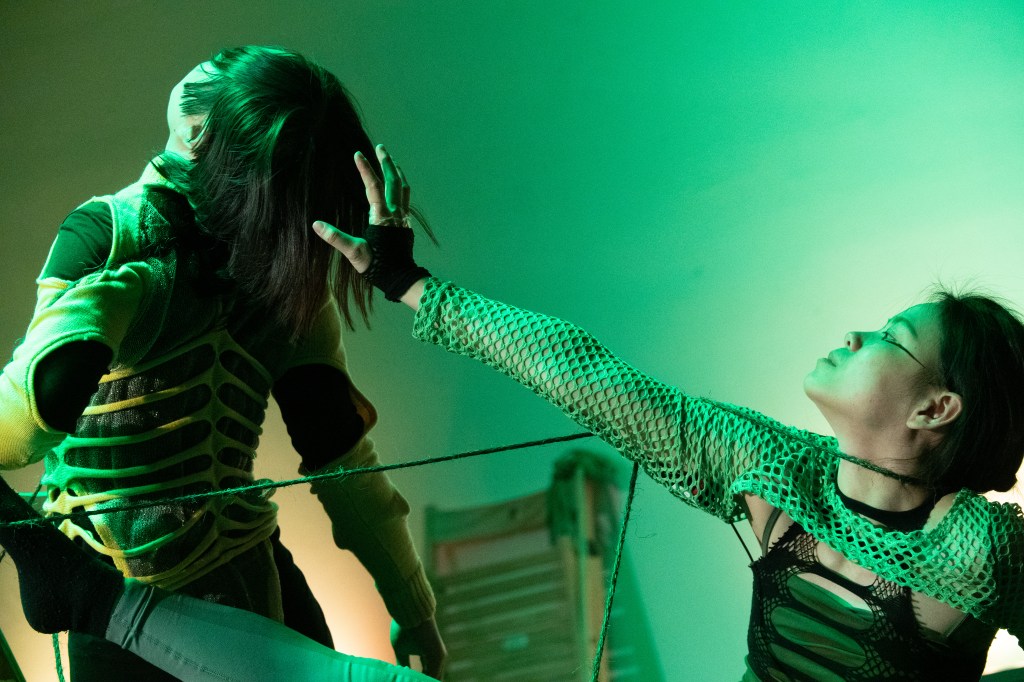
The performance is based on marginalized people’s remembrance of strings: knitting, weaving, tying, and binding. The performers use these actions against their stereotypical functions: instead of manual labor conventionally for women, we are exploring space, seeking connections, and sharing pleasure.
It premiered on December 12th, 2023, in Wharf, Yokohama, Japan, in the frame of the YPAM (Yokohama Performing Arts Meeting) Festival.
Dan Bau/Live Electronics/Performance: Tam Thi Pham Fixed Media/Voice/Performance: Dong Zhou Stage/Performance: elisELIS Dramaturgy/Visual Concept: Daria Geske Costume: Duong Ly Ba Lyrics: Susan Griffin (Song of Limit), Thies Mynther (Feed On Me) Recorder: Paul J. W. Schauenburg
Supported by the Hamburg Minister of Culture and Media, Yokohama Performing Arts Meeting, and many of our friends.
Congee Rats is Dong Zhou’s solo project, which uses electronic music as a starting point for radical boundary-crossing. Between dark wave, alternative rock, hyperpop, experimental, and cinematic soundscapes, songs emerge that absorb punk energy as well as influences from traditional music.
Congee Rats creates a dense, emotional universe: introspective, dark, and highly socially conscious. The lyrics and soundscapes deal with power relations, identity, and the experiences of marginalized communities. The result is a project that is both provocative and touching: electronic music as a message, performatively charged and always in search of new aesthetic friction.
DE:
Congee Rats ist das Solo-Projekt von Dong Zhou und versteht elektronische Musik als Ausgangspunkt für radikale Grenzgänge. Zwischen Dark Wave, Alternative Rock, Hyperpop, Experimental und cinemastischen Soundscape entstehen Songs, die Punk-Energie ebenso aufnehmen wie Einflüsse aus traditioneller Musik.
Congee Rats entwirft ein verdichtetes, emotionales Universum: introspektiv, düster und hochgradig gesellschaftsbewusst. Die Texte und Klangbilder setzen sich mit Machtverhältnissen, Identität und den Erfahrungen marginalisierter Communities auseinander. Das Ergebnis ist ein Projekt, das gleichermaßen angreift und berührt: elektronische Musik als Botschaft, performativ aufgeladen und stets auf der Suche nach neuen ästhetischen Reibungen.
I want to have the full experience I want to remember how this moment smells
I want to have the full experience It’s not enough to taste the pork I need to know it from piglet and how it felt when it knew about its fate
I want to have the full experience blood, sweat, urine, vomit Theses smells can not be used in perfume Because they are real I want to have the full experience I want to know the real things
I want to have the full experience Housework makes a place home dirt, hair, stain they make a place home I can’t always be a guest I want to do the maintenance
*I want to have the full experience I want to do the maintenance blood, sweat, urine, vomit they are the real things Please let me do the maintenance I want to know how this moment smells* (improvised, with free repetition)


 Dong Zhou